
Pacific Controls Galaxy
Platform of Platforms
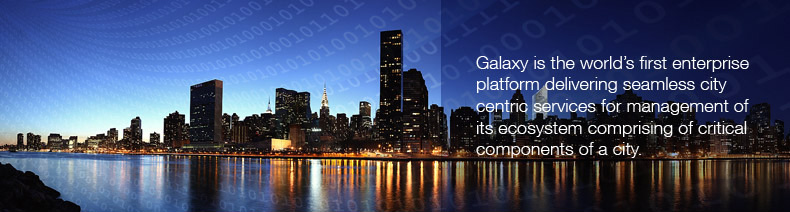
Pacific Controls Galaxy is the world’s first enterprise platform delivering city centric services for management of its ecosystem comprising of energy, real estate, homeland security, healthcare, hospitality, transportation, education, financial, industrial and retail.
Galaxy will integrate with management information systems to deliver optimization and governance centric data that will enable cost reduction of operating a city and its services through increased operational efficiencies and peculation of real time data to the relevant decision makers in the city.
Building owners, contractors, real-estate companies, government entities, and infrastructure owners like utilities , airports, telco’s can collaborate and leverage the resources of the Pacific Controls Command Control Center to optimize their operations, reduce their service costs, increase their return on assets and have the capability to remotely manage them in real time.
Galaxy offers modularity in application components. The framework is flexible, scalable and elastic to add on or trim down the functionality based on business process and key performance indicators around the ecosystem. The application layer of Galaxy is designed to deal with a range of services and it acts as a single point framework to deliver a unique proposition of services in a managed service delivery model.
The Galaxy platform enables third-party applications to be developed and integrated to be the part of the managed services ecosystem.
Pacific Controls will host Galaxy on its enterprise cloud that will enable any asset owner anywhere in the world to subscribe to the managed services offering in a cost effective manner. Multinational organizations will be able to leverage the Pacific Controls cloud to manage its business process and assets globally on a single platform.
The Pacific Controls Command Control Center is a new paradigm in city management and delivers collaborative solutions using ICT for the city’s ecosystem. Pacific Controls Galaxy addresses the challenges of climate change and the management of city’s resources by carrying out real time measurement and verification of its carbon footprint, converging services horizontally and vertically through the applications of ubiquitous technology enabling more convenient and quality life, safe and sustainable living environment through continuous and systematic management of the city’s ecosystem.
Technology for sustainable development
Global challenges
One of the world’s most pressing challenges is climate change: the need to radically reduce greenhouse gas emissions, while continuing to enable economic development worldwide, is a combination that requires innovative action. The most recent results presented by climate scientists are alarming. The accumulation of greenhouse gases (GHG) in the atmosphere is growing faster than originally predicted.
Global warming is a serious, perhaps even a grave societal issue. The underlying scientific basis of global warming is well established. The core problem is that the burning of fossil (carbon-based) fuels such as coal, oil, and natural gas leads to emissions of carbon dioxide (CO2). Gases like CO2, accumulate in the atmosphere and have a very long residence time, in the order of 100 years. Higher concentrations of GHGs lead to surface warming of the land and oceans. Over the longer run, this produces profound changes in many earth systems and consequently to biological and human activities that are sensitive to the climate.
The challenge of coping with global warming is particularly difficult because it spans across many disciplines and parts of society. Ecologists may see it as a threat to ecosystems, marine biologists as a problem arising from ocean acidification, utilities as a debit to their balance sheets, and coal miners as an existential threat to their livelihood. Businesses may view global warming as either an opportunity or a hazard, politicians as a great issue as long as they don’t need to mention taxes, ski resorts as a mortal danger to their already short seasons, golfers as a boon to year-round recreation, and poor countries as a threat to their farmers as well as a source of financial and technological aid.
To achieve these reductions it will be necessary to go beyond incremental improvements in energy efficiency, current life-styles and business practices. Improved energy efficiency for existing lifestyles, cars and domestic appliances may be enough to reach the initial Kyoto targets in 2012, but they will not be enough for deeper reductions. To achieve dramatic reductions of CO2 additional structural changes in infrastructure, lifestyles and business practice are necessary.
Around the world, major cities are reviewing their existing approach towards managing their assets as the implications of rapid urbanization, the recession and the looming threat of climate change are many and imminent. The realization of an integrated management tool for city administration/management has dawned throughout the world.
Smart City
Future of Smart City
We currently stand at a unique moment in history as technological forces gather to reshape the urban environment through the use of pervasive internet. Technology that integrates everything into a single system and enhances life with the power of internet.
Ubiquitous is the mega paradigm leading to the 4th revolution of pervasive internet following the agriculture, industrial and IT revolutions of the past, which will transform the life style for tomorrow.
The rapid convergence of mobile communications, M2M (Machine to Machine), automated positioning technologies, geographic information systems (GIS) and internet is raising the possibility of a dramatic transformation of the way we perceive and experience our environment, and interact with urban spaces. Endless possibilities for converged media using pervasive internet, are being proposed; that promise increased convenience, awareness, transparency and access to information. The integration of technology, information services and people’s lifestyles are intended to make life more livable, safer, comfortable and convenient in the ubiquitous city.
Cities are also growing to accommodate the increasing concentration of world’s population in cities. This situation had led to planners devising complex systems to deal with foods supplies, water supplies, waste disposal, traffic management and so on. Environmental sustainability is a major strategic component of this emerging model of city centric management as the progress of urbanization must guarantee safe and renewable use of natural resources.
The solution to keeping up with the pace of urbanization and also to progress lies in the ability to utilize networked infrastructure to improve economic and political efficiency and enable social, cultural and urban development. This structured approach provides innumerous avenues for optimizing performance and also generate savings without compromising on standards.
The performance of a city on a global stage currently not only depends on its critical infrastructure but also on its availability, quality and communication of knowledge. Cities today are looking to gain this edge to compete in the global markets and outshine competition. The current economic crisis has provided a global wake-up call to re-examine large complex systems. These along with the increasing importance of urbanization, climate change, new security concerns and global supply chains of food and medicine creates an undisputable mandate for a “Smart City” to enable urban development through modern Information and communication technology (ICT) innovations to address these challenges and also sustain under the current world scenario.
This concept of smart city spans the fields of energy, healthcare, transportation, water and building technologies, and this approach is well poised to tackle the problems faced by city decision makers. Pollution, increase in population, resource scarcity, traffic congestion, threat to public security, access to healthcare, are all growing at an alarming rate. These challenges described lead us to an important juncture where we must choose the newer more sustainable route towards development and prosperity. The greater challenge is how to improve the quality of urban life by ensuring harmonious growth. Intelligence is being infused into the systems, processes and infrastructure of the smart cities and this makes the life for billions of people easier.
The approach to these challenges is through technological progress and innovations. Operationally, cities are based on a number of core systems composed of different networks, infrastructures and environments related to their key functions: city services, citizens, business, transport, communication, water and energy. The need of the hour is to interconnect these systems in a synergistic fashion and transform them to work as a system of systems, making them smart moving towards a more citizen oriented approach whereby all these city services would be ubiquitous. The drive towards ubiquitous intelligence progresses along two dimensions: connecting everything and connecting everywhere.
What makes a city smart is its use of smart computing, internet and M2M technology to deliver its core services to the public in a remarkably efficient manner. Smart computing has a highly vertical industry focus: such as city administration, education, healthcare, transportation, utilities and cities are the microcosm where all of the industries intersect.
The management of the city will have a single tool to evaluate all options before considering a critical decision. The high inter-connectivity and flow of information will enable and empower key decision makers to accommodate for exhaustive variables. The smart city will ease the burden on the administration in terms of emergency response as the traditional silo approach will be discarded. Smart cities will be more dynamic in addressing resource utilization by shrinking the demand supply gap owing to key information being available real-time to the right people.
‘Smart City’ is one where current investments and modern ICT innovations are leveraged to deliver sustainable development and a high quality of life, with a judicial management of natural resources through new-age governance with the integrated management of information that creates value by applying advanced technologies to search, access, transfer, and process information.
Need for a unified platform of platforms
- Multiple data sources are mined and worked upon in a distributed data environment; this drives the data through cloud computing and continuous commissioning leading to action. This generates savings
- Provides visibility, transparency, accountability and interoperability.
- Access to all levels of data and detail for decision makers and or managers.
- Helps generate savings model across sectors
- Managed services from single point enables more focus on core activities for companies.
- Managed services delivered through a unified platform enables resource consuming processes to be outsourced.
- Empowers user to effect services and thereby promoting citizen oriented administration.
Galaxy is platform of platforms and it serves as a platform for developers’ community for mapping existing and new applications on a ubiquitous platform of services management.
In response to energy costs, environmental concerns and government directives, there is an increased need for sustainable and “green” business operations. Methods to measure power consumption and control energy output are now the focus of businesses worldwide, with people looking for consolidated energy management within and across cities.
Currently, there is no widely accepted platform for analyzing energy solutions. Different credible groups have proposed radically different energy solutions, in part because each uses different assumptions, baselines, input data, and system (problem) boundaries.
To ensure we can meet our future energy requirements we will require systematic consideration of many issues. A number of analysis frameworks are to be applied. In general, these frameworks involve.
- Definition of the problem to be analyzed;
- Selection of criteria or metrics for evaluating potential solutions to the problem;
- Identification of a full suite of known potential solutions, critical knowledge gaps, and required research agendas; and
- Comparative evaluation of the performance of potential solutions against the criteria or metrics.
Pacific Controls Galaxy platform has the answer to the future energy requirements of cities across the globe. Pacific Controls Galaxy is a robust energy management platform that allows operations and facilities to measure and fine-tune energy usage to realize significant cost savings. In general, the framework will embrace “big-picture” issues, such as costs (direct and indirect), potential efficiencies, feasibility, overall energy supply and balance, projected national and international demand, and environmental impact and sustainability.
The platform focuses on reducing power utilization on all assets using intelligent ICT based approach, allowing facilities operations to understand, optimize, and control power across an entire city infrastructure, potentially affecting any powered device.
The platform can be utilized to sharply focus the scope and define the energy system boundaries. Key criteria, carefully normalized, can be selected for analysis, such as cost per standardized mile, energy density by mass and volume, water consumption per standardized mile, greenhouse gas emissions per standardized mile, etc. Process boundaries and impacts can be clearly stated to facilitate comparison of systems, and stakeholders should be engaged throughout the process.
Being developed on an open framework technology, the platform provides an opportunity to the common users to utilize it according to their own needs and functionalities. This ensures that the platform or the user is not restricted only to certain analytical methodologies, fixed reporting and data visualization structure. Right from data mapping to developing complex equations to creating diagnostics rules to generating analytics and to visualization and reporting, the platform allows the user full freedom to regulate and monitor his assets across cities and the globe.
Galaxy is unique in the sense that it provides a normalized platform to any user, starting from a technician to a manager to a software developer.
In addition to the above, Galaxy provides an open platform to the vertical specialists such as OEM manufacturers who can utilize the software framework to develop their own knowledge base and use it for their monitoring and analytical purposes.
These make Galaxy an unrestricted universal platform which is beyond the realm of any software application available today.
Galaxy provides solutions for smart cities that help infrastructures to run on enterprise cloud platform. It is an enterprise cloud computing platform where it automates, secure and manages the smart city dynamically and can scale as per demand. Galaxy serves in enterprise cloud model wherein secured and seamless integration with any platform is possible.
Galaxy boasts a service oriented architecture (SOA) that enable integration with third party applications, through web services. An exhaustive set of application programming interfaces (APIs) are available to interested parties for accessing each service.
There are many platforms that a developer can choose for their applications. Each of these are mostly mutually incompatible i.e; an application developed on one platform will not run on another.
Therefore to maximize reach and revenue for the applications, a developer must decide carefully which platforms they will support. Galaxy also supports message oriented middleware for asynchronous bi-directional communication of data with third party apps.
The availability of such interfaces decouples dependency on Galaxy’s user interface (UI) and components, thereby encouraging third party systems to be a part of the managed services offering. The result is an ecosystem of disparate applications that synergize to create more value to the end customer. Since all interfaces available in Galaxy are platform independent, the developers are free to use any technology they deem fit to leverage the power of Galaxy in their own software.
Galaxy can handle most complex data integration challenges by providing the richest connectivity to thousands of data and application formats out of the box. Galaxy’s powerful data and application integration platform can be used not only for initial migrations, but for automated two-way data integration challenges and real-time message-based business integration challenges.
- Flexible- scalable to meet any integration scenario from large enterprise to small and medium business (SMB)
- Reliable- recognized world class service and support from an industry leader
- Affordable- right sized, right priced integration for everyone
Integration tools and support offer everything you need, software, pre-defined business processes, installation, configuration services and training. Galaxy’s ready to configure solutions dramatically shorten the implementation time, while eliminating the risk, complexity and high maintenance costs of custom coded solutions. Galaxy uses this model to deliver its state of the art solutions. Galaxy provides an integrated platform above ICT where the diverse information and data are unified to deliver a single tool for key decision makers and administrators.
Galaxy
Galaxy: Enterprise City management platform
Leveraging on the expertise of delivering managed services over a significant period of time Pacific Controls embarked on development of a software platform to support its managed services delivery capabilities. There was no available single software which could deliver the entire spectrum of expected functionalities required for life cycle management of the cities in totality. Pacific Controls has developed a sustainable framework in terms of its capability to scale up for enormous database management and handling.
Galaxy is an application frame work designed to deliver managed services while supporting both cloud and client- server architecture. A user for Galaxy can reach to the application platform by a subscription portal registration procedure.
The application layer of Galaxy is designed to deal with a range of services and it acts as a single point framework to deliver a unique proposition of services in a managed service delivery model.
Galaxy offers modularity in application components. The framework is flexible and scalable to add on or trim down the functionality based on business process and key performance indicators around that vertical.
Galaxy
Galaxy, the state of the art enterprise application framework, will integrate with management information systems to deliver optimization and governance centric data that will enable cost reduction in operating a city and its services through increased operational efficiencies and peculation of real time data to the relevant decision makers in the city.
Common scalable architecture
Galaxy Platform provides unique abilities for managing hundreds of controllers and thousands of data points.
High reliability
Installations with multiple operator posts and server clustering allow highly available systems.
Flexible access control
Hierarchical multi-user environment with different access permissions for operators, guards, engineers, and administrators.
Integration
Web-Service is available for easy integration with the other systems.
Event management
Centralized real-time monitoring, management, and logging of events originating from different building subsystems.
Alerting
Customizable alerts supporting different types of notifications (popup messages, e-mail, SMS etc.). Support for pending alerts and alert escalation.
Corrective actions
Alert-to-action bindings allow to execute corrective actions when alert is raised. Corrective actions may be controlled by an operator or executed in non-interactive mode with pre-defined user input.
Reporting
Advanced reporting facility, automatic report generation from any viewed/edited data. Built-in report editor, report printing and exporting in different formats.
Charting
Charting, support for a wide list of chart types, including dynamically updated charts.
Audit trail
Audit trail for monitoring mission-critical data. Every tracker has an unlimited number of user-defined states, indicated by color highlighting.
Task scheduling
Advanced job scheduler for periodic execution of any device-related or system actions.
Grouping
Grouping and group operations are available for different system resources and hardware devices.
User of Galaxy can select a service model applicable to their set up and infrastructure. User can make online service fee payments or renewal against selected managed service set. Galaxy supports a bidirectional communication possibility to ease end user while they provide the essential input to enable them online services.
Replication
Advanced replication of configuration between any similar system objects and devices. Configuration may be copied even between devices that use different firmware versions.
Asset management
Custom asset information can be associated with any piece of equipment. Asset events history is stored and available in the aggregated reports.
In terms of platform design, Galaxy has the system architecture in place to cater to the discrete functional needs for a diverse business vertical user stand point. Galaxy is a platform to transact services and expertise to deliver managed services package to its users. This flexibility enables a user to enter in to the world of pervasive computing and global enterprise solutions.
The application is browser independent to ensure its access to any given browser. Galaxy is first of its kind application to deliver specialized services components in a single window environment.
Modularity is the key in this development and the discrete modules addressing the need of the specific process support can be added to it as and when required. Galaxy is a modular packaging of a number of components which together makes this platform a unified solution in the context of energy optimization and analytics to achieve a proactive asset management regime.
Galaxy is also a framework with the capability to built interface to integrate with third party applications and platform. Galaxy offers an opportunity to build and integrate the various business vertical specific apps on the Galaxy development framework.
Galaxy is a modular packaging of a number of components which altogether make this platform a unified solution in the context of energy optimization and analytics to achieve a proactive asset management regime.
From an environmental standpoint, to meet the needs of property owners that are under increasing pressure to provide detailed accounting of their GHG emissions, Pacific Controls monitoring and reporting services provide transparent reports that provide accurate and reliable data on a building’s environmental practices. Whether from a green building or energy management perspective, Pacific Controls provides end users with the means to increase efficiency, generate cost savings, and provide energy savings as well as lower carbon footprint. The chart below illustrates Pacific Controls global excellence traits in the building automation industry.
Pacific Controls Galaxy is a tool to create a bridge that can move data to an IP network enterprise, Pacific Controls has opened the door to a world where device networking technology and system integration enable control over virtually any system in the world. End users can operate on a single unified platform with simple connection to real-time data, Web-based data and the corporate enterprise regardless of location. This convergence presented by Pacific Controls reflects an evolution of the building systems to an IP network, with financial incentives for building owners to integrate their systems and the important role of the building systems in controlling energy usage and costs.
Point metering framework
- Integration with real-time points and histories
- Ability to simulate meters with a combination of manual entry and automated processes
- Calculated meters using the equation framework
- Active time period definition for time-sensitive metering
- Rollover and warehousing of old meter data
Equation builder framework
- Visually formulating equations used in various engineering calculations
- Flexibility to write performance calculation logic for almost every equipment mapped with the application
- Combination of equation with automated and manual data as input
- Define equations once. Apply equations to multiple sets of input parameters
- Save equations as virtual meters for periodic calculation
- Nest equations inside equations to abstract complexity
- Support for both Boolean and numeric operations
- Custom operators can be developed and included in the framework
Energy analysis
Data mining and energy analysis
Galaxy’s energy optimization and analysis services empowers the facility managers and energy analysts to optimize facility energy consumption for higher efficiency of resources, lower operating cost, and reduced carbon emissions.
The powerful & interactive web based interface enables users to gain insight into energy usage information for IT equipment; data center infrastructure and facilities equipment and enable the optimization of the monitored environment from a centralized point of control.
A major concern of operations manager is the operation of facility not only in the most energy efficient manner, but also at the least cost. Both are difficult tasks, but the latter is most challenging. With electric and natural gas deregulation, there are many more choices for energy suppliers and additional choices for long-term energy supply contracts. These contracts normally have peak demand charges or the state’s public utility commission may mandate peak demand charges. To make sure the facility’s energy budget stays in the black, the facility must be operated not only in the most energy efficient, but also most power-demand efficient manner. The physical installation of associated metering, data logging is carried out separately at integration layer and this raw data is utilized by enterprise energy analysis layer. The software provides a single integrated energy monitoring and analysis system for recording, monitoring, recharging and analyzing electricity, gas, and water consumption, cost and carbon emissions.
The software will hold process and analyze historic consumption and energy financial data. The software is able to accommodate unlimited number of engineering data points, clients and customers. Each data point within the software is classified as a point. One major feature of the software is to accommodate multiple sites and customers across different geographies. Application is able to address multiple zone time difference issues. All inputs, outputs and changes will be fully recorded on a database and held for audit purposes within the system.
The energy analysis module enables data to be presented in a wide range of graphs, tables, reports and exports. In addition, reports may be run on an ad hoc basis, saved as templates for later use or scheduled for automatic production and distribution by email. Energy analysis layer enable users to easily configure reports using a number of powerful techniques, targeted at different areas of energy management. The interface should be extremely intuitive, ensuring that users are able to access and configure their data reports in the most informative way possible.
The energy analysis module provides a range of techniques which will be designed to specifically target different areas of consumption data. Designed in line with energy managers, each technique provides a range of options for monitoring consumption, comparing data and targeting different areas for improvement.
Customers are able to define a range of performance efficiency graphs to target process, chiller, boiler or site efficiency using a number of techniques, including specific energy consumption, regression analysis and targeting, deviation and CUSUM, rule based reporting and notification.
Users concerned with electricity analysis are able to configure reports to monitor contracts, available capacity, maximum demand and load factor.
The analysis should also include base load reports, league tables based on a number of different key performance indicators and profile reports. The energy analysis module will provide the user with a wide range of flexibility in how data is accessed and viewed.
Benchmarking different buildings or sites, energy data can be normalized by square footage, number of occupants, outside air temperature, cooling/heating degree days, etc. and categorized by geographical region, building type, business type, etc.
Key elements within Energy Analysis module are mentioned over here:
- Data Logging
- Data Mining
- Base Load Analysis
- Performance Analysis
- Budgeting/Forecasting
- Gap Analysis
- What If Analysis
- Regular and Customized Reports
- Tenant Billing and Invoicing
- Knowledge Base Mapping
- Centralized Energy Information Dissemination System
- Energy Usage Indicators
- Environmental Impact Indicators
- Climate Indicators
An enormous combination of standard and user configurable energy analysis charts are possible.
Graph designer framework
- Design graphs by drag and drop
- Multi-axis support
- Pie, bar, line, area, scatter, heat map, bubble charts supported by default
- Custom chart types can be built and added to the charting framework
- Benchmarking, trend lines/regions
- Automatic drill down on calculated meters
- Defaults for quick chart creation
- Define chart once. Apply to different sets of similar parameters
- Integration into the reporting and dash boarding framework
Dashboard builder framework
- A flexible framework to create dashboards and reports in accordance to KPIs
- User can configure and customize the dashboard windows and can edit the data representation layer depending on the user profile
- Application offers a number of regular predefined reports however user can also define and choose a report format
- Both real time and historical support
- Drag and drop charts, KB articles, meters, images, tables and gadgets
- Hyperlink components to other pages
- Automatic drill down
- On-the-fly modification of parameters
- Complex layout support, such as tabs, grids, view stacks
- Component framework for creating new components such as tickers, gauges, interactive 3d models etc.
- Save as template, for re-use in case of similar requirements (esp. mass deployment projects)
Report builder framework
- MS Word meets RIA
- A framework, not an application
- Easy drag and drop functionality for charts, KB articles, meters, images, tables
- Custom multi-page layout design with design guides such as alignment, rulers
- Batch process creation for automated report generation with automatic sliding timeline
- PDF support for custom reports. PDF, CSV and excel support for tabular reports
Fault detection and diagnostics
Expert rule engine system for fault detection and diagnostics
Increased business volume in days to come and advancement in expertise demands the fault detection and diagnostics to be done in a smarter way in terms of reducing the human dependency and thus minimizing errors in faults analysis.
Ensure no abnormal behavior of equipments goes unnoticed. The system need to ‘learn’ the analysis to the fault, form it as a ‘fault signature’ for the future reoccurrence of the fault.
The solution to this need is fault detection and diagnostic regime (FDD) component. FDD is an automatic process by which faulty operation, degraded performance, and broken components in a physical system are detected and understood. FDD tools are based on algorithms that process data to determine whether the source of the data is experiencing a fault. The tool may be passive, analyzing operation of the equipment/system without altering any of its set-points or control outputs, or active, automatically initiating changes to produce or simulate operating conditions that cover a more complete range of conditions that might not be covered for some time under normal operation.
The main objective of the FDD is to provide web based real time rules for proactive monitoring, diagnostics of faults and performance analysis. The system would cater to the following components:
- Identify/detect faults
- Analyze faults by information processing
- Provide diagnostics and results
The system will handle these aspects with followings as key functionality:
- Automatic data collection and archive : Collection of data from control systems
- Fault and event analysis rules based expert systems : Based on rules configured in the system
- Performance metrics manager: Information regarding identified KPIs like production, consumptions etc.
- Supporting continuous commissioning process : Fine tuning based on analytics outcome
- Translate the human calculations of the subject matter experts for diagnoses of a fault to be translated into a declarative programming language i.e. knowledge representation
- Assist to segregate data and logic. The data will come from the domain object model of FDD and the rules would be segregated into a central rule definitions repository.
- User interface /utilities for configuring rules in a convenient manner
- Help to cater the changes in the rule definitions efficiently and in a controlled manner
- Making the diagnoses efficient and less error prone over a period of time
- The fault occurrences communicate to the rules engine which would then use its rule repository to publish the diagnoses of the situation, using which the user/system can act upon.
The application has a configurable rule engine. The rule engine targets are:
Rule-based system consist a set of if-then statements, but provides the basis for “expert systems” which are widely used in many fields. The concept of an expert system is to capitalize on the knowledge of an expert that is encoded into the rule set. When exposed to the same data, the expert system artificial intelligence (AI) will perform in a similar manner to the expert.
Fault detection and diagnostic mechanism is incorporation of human expertise and rules driven decision making action by the application automated and in real time.
Automated system generated action for
The causes of the fault using computerized information processing
- Identifying degradation in the performance of equipment or systems
- Provide advisory service/ support the operations
- Inbuilt diagnostics based on
- Rule-based expert systems
Fault Detection and diagnostic Framework
FDD is an integral component in maintaining building systems at their optimal performance and reliability. Based on rule-based expert systems, and predictive intelligence of the software, users can identify degradation in the performance of equipment or systems and take preventive actions.
Carbon footprint measurement and GHG accounting
The carbon footprint is a powerful tool to understand the impact of personal behavior on global warming. Most people are shocked when they see the amount of CO2 their activities create! If you personally want to contribute to stop global warming, the calculation and constant monitoring of your personal carbon footprint is essential. The total amount of greenhouse gases produced to directly and indirectly support human activities is usually expressed in equivalent tons of carbon dioxide (CO2).
It is of utmost importance to deploy a mechanism for accounting of green house gases starting from residential to corporate enterprise level. The traditional approach of accounting for GHG’s include use of worksheets where data is collected manually and fed into the same. The data is then compiled and calculated to give you the amount of GHG emissions as a whole. The process becomes tedious and there is high probability of error due to human interface.
This GHG protocol corporate standard provides standards and guidance for companies and other types of organizations for preparing a GHG emissions inventory. It covers the accounting and reporting of the six greenhouse gases covered by the Kyoto Protocol, carbon dioxide (CO2), methane (CH4), nitrous oxide (N2O), hydro fluorocarbons (HFCs), per fluorocarbons (PFCs), and sculpture hexafluoride (SF6). The standard and guidance were designed with the following objectives in mind:
- To help companies prepare a GHG inventory that represents a true and fair account of their emissions, through the use of standardized approaches and principles
- To simplify and reduce the costs of compiling a GHG inventory
- To provide business with information that can be used to build an effective strategy to manage and reduce GHG emissions
- To provide information that facilitates participation in voluntary and mandatory GHG programs
- To increase consistency and transparency in GHG accounting and reporting among various companies and GHG programs.
- To address the anthropogenic effect on earth in a quantified way
- Sharing and dispensing the sustainability data
- User should be at ease in understanding and take necessary steps to increase sustainability rather investing time in calculations
- Keep track of activities, that impact more in generating carbon foot print
- Use and test alternative ways to reduce the overall impact
- To align work flow toward the greater concern of UNFCCC
There are various aspects to be considered while capturing the input for the application. These inputs to be utilized by calculation engine for producing the desired output of the application. Inputs of the application will be of following categories –
- One time entry to be done in the beginning of the application configuration and will change only if some regulation or calculation factors changes notifications by regulatory bodies
- Real time data captured from field sensors or energy meters. Provision to be kept for manual data entry also.
- Entry of the data not available for real time integration can be captured in following two ways-
(i) Average monthly figures
(ii) Actual data entry by the end user every month
Knowledge management framework
- Centralized depository of information and knowledge base
- Assignment of unique identification codes
- Automated recall of knowledge IDs based on expert rule based system
- Continuity of data and information to ensure reusability and accessibility when you need it
Facility Management
Galaxy enabled facility management
Facility management services on Galaxy platform provides hosted, on-demand, managed, FM resources available as a web service. We collaborate to extend managed facility management services on 24x7x365 basis. The dynamic set of web and PDA enabled resources allows you to manage your facilities, without upfront investment in hardware or software.
Highlights of capabilities
- Is a modular facilities management system
- Allows day-to-day management of the processes
- Automates operations
- Provides a management dashboard for critical analysis
- Enables enterprise wide control in the most intelligent and efficient way
- Integrates all various process and procedures onto a single, intelligent network-based software solution
- Centralized repository for all the property’s assets, monitoring of budget/expenditure, maintenance records, management reports with KPI etc
- Enhance the response to tenant’s feedback/response. Automated tracking thereby improving customer service
- Optimize operating/running costs
- Improve staff productivity as the system can intelligently search for data more expeditiously allowing them to focus on other key issues
The FM elements
- Asset Management
- Property Management
- Maintenance Management
- Stores/Inventory Management
- Time & Attendance
- Helpdesk & Knowledge Base
- Drawing Management
- Document Management
- Tenant Billing System
- Key Process Indicators (KPI)
The solution provides capabilities for maintenance management system, provides enterprise asset management, property management and computerized maintenance management features that facilitates the asset managers to track, maintain and manage their assets, properties, facilities and equipments, and get the best performance by them through out their life-cycle.
Key functionalities are summarized hereunder which are very much essential to form a systematic and process driven asset management regime:
Maintenance management
- Preventive (Scheduled) Maintenance
- Corrective (Ad-hoc) Maintenance
- Maintenance Policy & Best Procedures
- Work Orders Management
- Inspection / Readings
- Resource Scheduling
- Technician/Labor Management
- Time Cards
- Downtime
- Planning
Corrective & preventive maintenance management
- Tool for monitoring maintenance and repair job request
- Storage of equipment data
- Scheduling work orders to perform maintenance jobs – routine/preventive maintenance
- Provide flexible working methods such as managing work through instant work orders, On-demand work orders and preventive maintenance work orders.
- Generate periodic reports and queries that include charts, database tables, drawing and images
- Standard maintenance services
- Allows building of templates for recurring maintenance activities
- Manual & automatic
- Maintenance job requests
- Event of equipment failure
- Escalation of job request
Asset registration and tracking
- Maintain complete details of each equipment / asset in a plant or facility
- Supplier and warranty information of each equipment
- Tree structure to allow for a parent child relation between equipment
- No limitation in the number of equipments
- Physical characteristics of each equipment including height, width, depth and color
- Registration and certificate numbers for each equipment
- Move equipment from one parent (site) to another
- Track movements of equipment
- Purchase cost and depreciation calculation
Work orders management
- Work orders can be created for every maintenance task
- Estimated and actual costs for each work order
- Estimated and actual labor and spare parts required
- Link external files to print work orders – MS Word, MS Excel, other file format
- Create work orders from customer’s job requests
- Resource scheduling - scheduling work for any day, week, month of any year for any equipment, trade or trades person
- Add history at any time during a job
- Create work orders from standard jobs
- Add safety notes and instructions to each work order
- E-mail escalation on work orders yet to start after due date.
Performance history analysis
- Failure analysis codes
- Downtime and repair time reporting
- Full description of each job done
- Add history without work orders
- Store readings of equipments. Eg. hours, kpa, amps etc.
- Use readings to trigger maintenance policies
- Calculate average usage rates for all equipment
Downtime management
- Register downtime of all equipment / plant
- Instantly produce daily and weekly downtime reports for use by management
Maintenance policy engine
- Plan all the work on any preventative maintenance or routine job including all resources. Schedule maintenance by hours, weeks, years, kilometers etc
- Two type of policy. The first type is calendar based - e.g. days, weeks, months and years. The second type is usage based - e.g. hour meter for hours, odometer for kilometers, weight meter for tones, etc.
- Create work orders for the created policies when they are due. By running the activator, MMS will select the maintenance policies that are overdue or due in the near future and turn them into work orders for each equipment
- Labor resource requirement and spare part requirement planning
- Provide an area where you can store all your standard jobs. A standard job is a job that is planned (resourced), but not scheduled on a routine basis. The standard job can be turned into a work order when required
Procurement management
- Vendor management
- Contracts management
- Alerts on contracts nearing expiry
- SLA management
- Rate contracts
- Alerts on rate contracts nearing expiry
- RFQs & quotations
- Quotation analysis and order placement
Contracts management
- Contracts storage and retrieval with attachments
- For scheduled and corrective maintenance service, procurement, projects etc.
- Vendor details, contract details, terms of payment, contract & warranty period, insurance details etc
- Service level agreement (SLA) for the contract can be defined
- Three levels of auto reminders for contract end, warranty end
- To link to one or more facilities
- Provision to store contract sum and the variations
Service Level Agreements (SLA) management
- SLA or service level agreement can be defined for any job type and priority combination
- Analysis and escalation can be set against “Status” codes
- Status can be “Response”, “Start of Work”, “Completion” etc.
- Escalation time and the person to escalate can be defined
- SLA’s can be linked to a contract or a maintenance policy (or facility) or a work order directly
- SLA analysis and escalation can be done for internal work orders also
Inventory management
- Master inventory list
- Purchase requisition
- Ordering
- Inward / returns / issues
- Multi-warehouse
- Min/max/levels
- Online stock updates
- Automated re-ordering / alerts
- E-mail escalation if the ordered items are not received after raising the purchase order.
- Record all the spare parts for maintenance/repair purpose
- Charge out spare parts to customers
- Create purchase orders for store purchase
- Manage all suppliers and contracted rates for spares
- Analyze the usage of all spare parts
Service invoicing management
- Generate invoice for a work order, or for ad-hoc invoicing
- MMS quote cost directly from the work order or use the quoted price on the invoice
- Maintain discounts for each supplier. This will show on all invoices for the respective customer
- Trade labor costs can be charged out differently to each customer
KPI management
- Standard KPIs – preventive maintenance backlog, MTBF (Mean Time Between Failures), overdue PM work orders, maintenance cost variance etc
- Provision to drill-down and view detailed report
- To create custom KPIs and KPI charts and associate detailed drill-down reports
- Custom KPIs can be linked to menus and privileges can be defined.
- Provision to auto-refresh to show latest data.
- Gauges, bar charts, pie-charts etc. available
Helpdesk and knowledge base management
- Online call booking, emails, tele-calls and control system alarms
- Register problems, job requests, calls
- Priority assignment, nature of faults
- Assign, distribute, monitor
- Escalation based on standard SLA
- Recording of all events throughout the life cycle of a call
- Raise, track and close work orders
- Record solutions and post in knowledge base
- Service level analysis
- Faults and solutions history
- Fully indexed data for fast searching
- Simple and advanced search functions
- Call response analysis
- FAQs and links
- Improves customer satisfaction
Drawings and documentation management
- Drawing and document management system is a digital management tool to store, track and manage information of all the drawings, documents, manuals, software etc. associated with the facility / building systems
- The floor plans, equipment drawings, building plans, technical drawings, wiring diagrams, network diagrams etc. can be securely maintained and managed via the system
Tenant billing and process management
- A system to capture the utilization of services/utilities of tenants and generate bills for the same
- Manages property information, tenant information, lease information and owner information
- Manages tenant subscriptions and their history
Transportation
Galaxy enabled transportation
Transportation can benefit from Galaxy to create better functionalities that are beneficial to users and companies. Such an example is the management of traffic. Galaxy can assist in a better experience by connecting traffic management systems online.
The management and operation of traffic lights can monitor traffic patterns throughout the day. The data collected can assist in better time management of how long a stop or go signal should stay on. Each traffic light could count the number of vehicles that pass by it at every set interval. The data collected could then be forwarded to the next set of traffic lights which may be an intersection to manage better volumes of vehicles. Monitoring of vehicle accidents is possible with traffic lights managing amount of traffic to pass without creating congestion. Traffic light management can be an automated system continuously relaying data to a control center that can overlook any issues or faults.
Businesses can also benefit from Galaxy’s possibilities of transportation. One such example is a taxi service for the scheduling and pickup of customers. Galaxy could enable a taxi service to monitor the location of the fleet of taxis from the use of GPS navigation. Any available taxis within the immediate area can then be directed to the customer’s location. Many current mobile phones have multimedia abilities such as to browse the internet with navigational maps built into the phone to enhance functionality. A customer who has the functionality of sending GPS coordinates can send the data to the taxi service to minimize confusion over location. The communication that is possible with transportation can also benefit airplanes, ships and boats relaying data to a centralized control center. The monitoring of remote equipments such as airplanes electronics can be monitored for information that can help detect faults, check air pressure of tires, fuel pressure, fuel level and air quality. The constant relaying of data/information provides a reliable and robust service. Galaxy allows the monitoring to be automated with real time alerts and notifications of systems.
Galaxy enabled health care management
Patient-centric health care system to empower individuals and hospitals Galaxy is bringing about a revolutionary transformation in the health care sector by replacing outdated technology. Galaxy connects systems that empower better functionalities and performance for patients, doctors and insurance providers by sharing of data in real time. Galaxy’s next generation ICT solutions provide a unique functionality and possibilities that add value to the healthcare systems applications, databases and networks.
Providing inter-connectivity to multi-protocol health care devices and across applications, databases and networks, Galaxy ensures a unified platform for managing end-to-end healthcare. Furthermore, this platform can help the healthcare system adapt more responsively, and improve the quality of care at a lower cost.
Retail management
Galaxy enabled retail management
Bringing in an enhanced experience for both retailers and customers by empowering retailers with maximum efficiency. The structural and evolutionary characteristic of the retail sector gives Galaxy a very important role. In addition to the necessity of upstream integration in the supply chain and of downstream communication with the customers, what is needed is the connection and exchange of information within the same company.
Retailers are always looking for an edge. With margins tight, companies seek solutions to help run their daily operations smoother, faster, and cheaper. Galaxy will empower retailers to choose and maximize efficiency in a wide variety of business functions while enhancing the retail experience for both retailers and consumers.
Galaxy provides energy and asset management by storing and analysis of data with monitoring and diagnostics of areas such as heating/air conditioning, lighting, power consumption, coolers and other fixtures within the retail environment from a Global Command Center (GCC).
Galaxy provides an on-screen summary dashboard for easy management review and decision-making. An example of this is a cooler that needs to keep a consistent temperature during the day. Galaxy can notify in real time the operation of the cooler with accurate readings of temperature. If the cooler were to go out of range of set temperature, fault detected or maintenance is required, Galaxy can alert with detail of the issue. Retailers can optimize power and energy consumption by establishing rules to avoid peak utility rates, maximize uptime, protect inventory, and comply with guidelines for food storage.
Building management
Galaxy enabled building management
Transforming buildings into a well managed and monitored strategic business asset with minimal investment.
Galaxy enables transformation of Buildings into prosumers acting as a demand response management system. Galaxy has the capability to connect to the advanced metering system and collate all the data in real time for utility companies to analyze it and act accordingly in times of peak demand, load shedding, demand management etc. Galaxy takes a holistic approach by looking at buildings as a “Device Ecosystem” and consolidates multi faceted information about them. This information presented in intelligent visual representation could be used to take actions concerning energy optimization, cost reduction for maintenance, asset management. The energy information could be used by smart grids for demand response management.
Today, companies are more concerned about the impact of their building, and the global environment. As a service provider, we are also equally concerned about this, and enable buildings to seamlessly fulfill their mission while minimizing energy cost, supporting a robust electric grid and mitigating environmental impact. Galaxy solutions create buildings of the future by interconnecting the various pieces in an integrated, dynamic and functional way.
Hospitality management
Galaxy enabled hospitality management
Integrating the best technology to provide the guest with a differentiated and highly personalized experience.
Galaxy’s integrates the best that ICT & M2M technology has to offer to provide the guests with a differentiated and highly personalized experience. Galaxy leverages the power and dynamism of this pervasive industry and our solutions intend to improve the efficiency and delivery of hotel operations, such as front desk, housekeeping and guest services. Galaxy enables smart hospitality service by integrating guest room automation services with intelligent data analysis and enables hotel owners to customize their personal services as per guest habits and needs. At the same time Galaxy enables energy & asset data to reach the facility manager in a highly personalized and visually rich format to reduce total cost of operations
Galaxy’s hospitality solution addresses typical operational concerns of various functional departments including front office, room sales/marketing, housekeeping, engineering and security. The guest room automation system enables seamless integration with HVAC, lighting, room safes, mini bar, door locks, computerized maintenance management system and guest room management systems.
Galaxy enabled education
Technology enabled learning is an inevitable paradigm shift to a learning environment underscored by information and communication technology tools, protocols, infrastructure and digital content. Galaxy’s wide –ranging and integrated educational network enhance the possibilities within the education sector by sharing and relaying of data in the continuous communication between teachers and students.
This exceptional approach of long distant learning with up to date progress information, adds value to the teacher by better understanding of the students to create and tailor new teaching practices. With the new teaching practices, teachers can share the gained knowledge and provide the information across the internet to other schools and facilities across the world. This creates a community of information sharing based on real inputs of students. Galaxy also provides detailed graphical representation of student performances, energy usage within facilities and how to optimize these assets.
Security and emergency response
Galaxy enabled security and emergency response
The World Economic Forum in its Global Risks report 2010 has reported that the world is seeing an increase in the interconnections among risks; this means that it is imperative to move on from the typical silo approach to a more holistic view of threats to increase our survivability. It is important to adopt a preemptive approach to threats and disaster management to reduce the impact of the event. Galaxy does exactly this; it is capable of providing solutions to all phases of security and disaster management.
Galaxy enabled solutions offer the emergency management field more flexibility, speed of reaction, better interoperation of various agencies and efficient international collaboration, more effective resource management and better focused deployment.
The ability to communicate instructions during a crisis is central to the effectiveness of a procedure. Communicating accurate and detailed information represents an important challenge which Galaxy addresses across the sectors.
Public safety agencies such as fire department, homeland security, paramedics, border security force often use different types of communication networks for their communication. Galaxy provides a platform to integrate data from various devices for seamless information flow, and offers individual and comprehensive solutions for public security. Our implemented end to end interoperability platform provides better functionality and response by integrating security solutions, emergency management systems, and border control systems.
Galaxy enabled industrial automation
Ensuring the optimum performance of assets across diverse industries through continuous monitoring, benchmarking and high operational standards.
Galaxy is driven by ever-evolving consumer demands centered on continuous innovation and cost-efficiency through innovative communication designs. Galaxy’s solutions can enrich the functionalities of the industrial appliances by connecting these onto the internet, creating a real time monitoring and control of assets.
Furthermore, it guarantees the optimum performance of assets across diverse industries through continuous monitoring, benchmarking and raising operational standards. This platform also ensures reduction of all costs related to the industry, and asset can be maintained end-to-end through 24x7x365 days monitoring, reporting and analysis.
Industrial automation
Airport management
Galaxy enabled airport management
Airports are critical infrastructures which run multiple sub-systems to ensure safe and speedy transit and humans and materials. These systems are highly efficient but work independently. Galaxy as a solution provides management level interface among the different sub-systems in the airport like fire alarm, security & access control, building management, integrated aircraft stand system, CSM- horizontal vertical transport system, and management information system etc. Galaxy through its unified architecture can enable information from disparate systems to flow freely creating a high level functionality that is prerequisite for today’s modern airports, adroitly designed to create a reliable and robust system in airport management.
Galaxy solutions provide operators all relevant risk information within a central system, creating fast, intelligent event response by reducing the risk and time associated with gathering and interpreting data from individual systems. The unique feature of this technological architecture allows customer the freedom and flexibility to choose appropriate procedures directly into the system, and also a cost-effective transition to digital infrastructure.
Galaxy enabled energy services
Working with existing and new energy resources to leverage and optimize efficiency by constant device maintenance through M2M technologies.
The imbalance between supply and demand of World’s energy is seen as imperishable. With the advent of mainstream “clean” energy such as off-shore wind turbines and photo-voltaic, it is ever so important to maintain the flow of information amongst the producers and consumers of the different types of energy. The advantages of doing so are numerous such as the ability to provide dynamic pricing models, raise the number of “flexible” consumers by improving visibility into complete energy process, and empower the ‘smart grid’ etc.
Galaxy has the ability to connect various grids and enable flow of data between the grids for optimum performance and least wastage. The uniqueness of Galaxy is its capacity to interoperate between diverse systems and this is most crucial in the current scenario where multiple energy sources are leveraged to meet the demands of the Worlds consumers. Galaxy considers an ecosystem rather than the traditional silo based approach for energy management. This ensures efficiency and optimum performance across the energy enterprise.
Galaxy has the ability to work end-to-end ranging from the actual device producing the energy to the device consuming it. This span of information enables decision makers to comprehensively evaluate options before them.
About Pacific Controls
Technology for sustainable development
Pacific Control Systems LLC
(PCS) is an ISO 9001:2008 company providing total automation solutions globally. Headquartered in Dubai, PCS has been involved in successfully implementing integrated automation solutions in the government and private sectors.
Pacific Controls’ core strength is in offering comprehensive, innovative solutions in intelligent automation and control systems. Our domain knowledge coupled with technology expertise is continuously being updated and applied to create total automation solutions in commercial, industrial and home infrastructure projects. Pacific Controls’ technology expertise as an e-Enabled solutions provider has resulted in incredible business successes in implementing total control solutions for commercial, industrial and home infrastructure automation projects. PCS strategies and services are in line with its commitment to sustainable development and energy savings built on economic progress, social development and environmental improvement.
PCS’s services have a wide range of end users like building owners, contractors, real-estate companies, governments and government agencies and general infrastructure owners. These key players can collaborate and leverage the resources of Pacific Controls command control centers to:
- Optimize operations
- Reduce service costs
- Increase return of assets
- Monitor assets remotely
Among its leading services, Pacific Controls offers remote monitoring, energy management, building commissioning, and facilities management services. Pacific Controls services are designed to lower building operating costs by monitoring and control of energy-intensive systems such as HVAC and lighting, which can be measured for optimum performance and predictive maintenance needs, reducing both energy usage and operating expense.
Pacific Controls, in addition to the enterprise level applications and solutions, provide the services of subject matter experts (SMEs) from diverse fields such as energy, HVAC and electrical, round the clock, who continuously keeps a hawk’s eye on systems and their performance. SMEs are responsible on how tasks, to include the order of performance steps, are to be performed, are responsible for providing technical advisories, responsible for acceptable performance levels and for providing the performance objectives.
Nearly 20% to 30% of the average energy consumption could be influenced by Pacific Controls software. Users can use the interactive energy management tools to create energy management profiles that are triggered by certain established consumption rates. As energy consumption exceeds a specific point, the system can automatically begin turning off low priority lighting, heating, and cooling zones. An effortless way to green your space is to take control of your energy consumption by finding out exactly how much you are using. Armed with software tools, you can measure how much electricity a device uses, or find out how much electricity your whole workspace uses. The application provides monitoring of cost of electricity usage as per laid down tariffs based on slabs or any other rate patterns such as peak rates and off-peak rates. It can be programmed to reflect two rates one for off-peak periods and one for peak periods so you know how much money you’re spending on electricity at any given time. Once you determine these facts, you can reduce usage or replace energy consuming devices with more efficient items. These real-time energy usage indices help you understand your habits and can get you to become more efficient with your energy consumption needs.
Pacific Controls offers cost-effective deployment of specific ubiquitous ICT systems along with the seamless adaptation of moving environment context, incorporation of the human dimension in ICT, especially through solutions that are “accepted” by the user, e.g. with systems naturally interacting with the user, with systems having the capacity to learn and adapt themselves to the way of living or working, with dynamic adaptability to the user specificity overall issues related to human activity and energy efficiency, and to the design of interfaces accordingly; adaptation to the user’s instantaneous activity, situation and context; understanding and development of quantitative tools that match reality; scaled and selective mining, as well as visualization.
Development of mature cross-domain / multi-disciplinary software tools and ICT based services for industry; development of formal models for performance metrics for sustainability and energy-efficiency in buildings and urban areas.
Pacific Controls offers end to end platform that proactively monitors facilities such as commercial buildings, educational institutions, banks and financial institutions, government service infrastructure like airports, ports and railway infrastructure, residential buildings, data centers, industrial facilities, telecom infrastructure and power distribution network. This platform provides unambiguous transparency into how the facility performs, where critical faults lie, and where opportunities exist to significantly reduce operational expenses. This groundbreaking communications architecture further enables integration with existing enterprise business and ICT processes, such as integration into ITIL/ITSM programs and infrastructure.
This robust M2M communications and automation platform can easily be tailored and expanded to manage and report any number of facility infrastructure assets from any standards compliant manufacturer. Our modular approach, built on a proven architecture, enables intelligence across power generation and distribution, cooling and heating equipment, lighting and environmental systems, water and waste systems, security systems and other subsystems.
Remote monitoring and management is rapidly becoming an integral part of service management architecture globally. Conventional methods of management, where data logging and equipment registers are maintained and reactively reviewed, are obsolete and ineffective. Under our state of the art automated management framework, we apply deep analytics to the review of streams of logs and performance data from infrastructure devices. This logic, akin to data mining and profiling, provides deep insight and intelligence into the real time and trended performance and capabilities of infrastructure assets.
Our solution provides the means to understand the scale of any problems and opportunities through the establishment of benchmarks, baselines, and performance and consumption metrics and targets. Valid trending analysis requires extensive ongoing capture and analysis of data from infrastructure assets, which is core strength of our solution.
Pacific Controls have pioneered ICT solutions for managed services in the building domain. PCS delivers large scale solutions of energy management in public and commercial buildings and has established the concept of city centric management. It is in the process of establishing Global Command Control Center (GCCC) for managed services around the world.
Pacific Control Systems offer managed energy services for continuous online monitoring and reporting of consumptions trend, measurement of equipment performance and benchmarking. Pacific Controls operates a state-of-the-art Global Command Control Center (GCCC) that provides 24X7X365 days customer support by remotely monitoring customers’ assets. The GCCC has developed a procedural and intelligent management regime of building services for energy optimization and optimized operations. This facility is one of its kind in the world and PCS offers its invaluable services to its clients. PCS is in the process of establishing GCCC; worldwide to enable the best services for clients across geographic barriers.
The services of energy monitoring, continuous commissioning (CC), fault detection and diagnostics (FDD), measurement and verification (MV), carbon footprint analyses and GHG accounting are being delivered through a single application framework; Galaxy.
Galaxy is an end to end platform that proactively monitors assets, providing transparency into how the facility performs, where critical faults lie, and where opportunities exist to significantly reduce operational expenses. This groundbreaking communications architecture further enables integration with existing enterprise business and ICT processes.
This platform delivers the key services through the established infrastructure of the GCCC and all features available through the Internet. The GCCC’s around the world will be linked to all the control devices installed at the client’s asset premises which enable the provision of seamless asset management.
PCS uses state of the art infrastructure and a very unique application platform for deployment of these services. The software services are offered through a managed service delivery platform & utility computing environment. The application framework is hosted on enterprise cloud managed by PCS & the application is deployed on a SaaS Model. This model empowers the customers in terms of reach & flexibility. The services are ubiquitous as its foundation lies on an enterprise architecture and is browser based can be accessed by the users from anywhere across the globe.
Pacific Controls, in addition to the enterprise level applications and solutions, provide the services of subject matter experts (SMEs). These individuals are handpicked from key fields such as energy, HVAC and electrical systems to continuously keep a hawk’s eye on systems and their performance. SME will ensure that the performance of operations within an asset is optimized and monitor them closely for any deviation from set standards. Technical advisories are also provided in addition to tweaking of key parameters at different levels for complete system efficiency.
Pacific Control’s Managed Energy Services complement the existing building electromechanical systems by bringing the energy data on an industry standard open framework. This provides a single bench user interface with a central repository for data and information management. Solution also offers higher ease of use by providing anytime, anywhere access to the building information on laptops or hand held devices for immediate response to the facility’s needs.
Pacific Controls has hosted Galaxy on enterprise cloud, which will enable any asset owner anywhere in the world to subscribe to the managed services offering in a cost effective manner. Multinational organizations will be able to leverage the Pacific Controls cloud to manage its business process and assets globally on a single platform.
Pacific Controls GCCC service model enables governments to provide better levels of efficiency for service delivery and meeting the expectations of stakeholders. Through the use of analytics and modernization of operations, the solution will facilitate significant changes in organizational culture and allow city management to better allocate resources and investments in infrastructure. The city centric GCCC services are designed to streamline operational expectations beyond boundaries and create multi channel communications among ‘service users’ and ‘service providers’.
Pacific Controls provides world class ubiquitous city services by converging services horizontally and vertically through the applications of a the new paradigm of ubiquitous technology enabling more convenient and quality life, safe and sustainable living environment through continuous and systematic management of the city’s ecosystem.