
Press Releases
PACIFIC CONTROLS LAUNCHES GBOTS, (VIRTUAL ROBOTS) FOR ENERGY SERVICES AND FACILITIES MANAGEMENT.
The revolutionary technology is expected to change the dynamics of energy management, system support and maintenance using wired and wireless networks, globally.
Dubai, November 11, 2010: Pacific Controls, the Dubai-headquartered world class developer and provider of global total automation solutions, announced the unveiling of Gbots (Virtual Robots), a pioneering technology that will transform energy and facility management enabling complete remote management and maintenance using distributed intelligent systems on wired and wireless networks.
The announcement was made by Mr. Dilip Rahulan, Chairman and CEO, Pacific Controls, at the CoRE Tech 2010 event in Chicago.
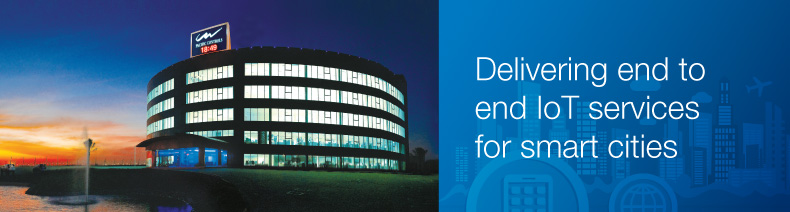
Pacific Controls, whose headquarters is the only Platinum rated Green Building in the Middle East region accredited by the US Green Building Council, developed Gbots as part of the evolution of “Galaxy”, the world’s first enterprise platform for management of citywide services ecosystem.
Commenting on the launch of Gbots, Mr. Dilip Rahulan said: “Gbots are the new paradigm for the virtualization of managed services. The intelligent, autonomous, selflearning software agents will be deployed across networks for diverse automated services. This ground breaking remote infrastructure and energy management technology from Pacific Controls offers the world the opportunity to save as much as 50% in energy costs.” He added: “We have received an overwhelmingly positive response to Galaxy. Organizations around the world have embraced our innovative service delivery platform. The success of Galaxy has encouraged us to accelerate the introduction of new innovative features to extend our platform’s capabilities.“
Gbots run autonomously, sensing and acting on dynamic conditions in facility and energy systems. They possess sophisticated capabilities, including analytics to recognize complex patterns of systems behavior. Coupled with the Galaxy platform, Gbots will drive next generation equipment maintenance and customer service, enabling early fault detection and real-time predictive and self healing systems. Galaxy and Gbots support 3rd party agent development utilizing the Gbots application programming interface (API).
From smart Grids to large complex machinery, smart agents (Gbots) leveraging Pacific Control’s global Service Delivery Platform - SDP (Galaxy) have the potential to play a pivotal role as the “first line of response” to solving equipment and systems problems. Their primary goal is to manage and optimize assets and to make critical sensed data available to the system to auto diagnose and resolve problems without unnecessary human intervention.
Galaxy acts as platform for software developers to develop their applications in a managed services framework. Galaxy boasts a Service Oriented Architecture (SOA) that enables integration with 3rd party applications, through web services. An exhaustive set of application programming interfaces are made available to interested developers for accessing services. Galaxy also supports message oriented middleware for asynchronous bi-directional communication of data with 3rd party applications. The availability of such interfaces decouples dependency on Galaxy’s user interface (UI) and components, thereby encouraging third party systems to be a part of the managed services offering. The result is an ecosystem of disparate applications that synergize to create more value to the end customer.
Since all interfaces available in Galaxy are platform independent, the developers are free to use any technology they see fit to leverage the power of Galaxy in their own software.
Pacific Controls’ Galaxy integrates management information systems to deliver optimization and governance centric data. This enables cost reduction of operating a city and its services through increased operational efficiencies and presenting processed real time data to the relevant decision makers in the city. The system comprises of management of energy, real estate, homeland security, healthcare, hospitality, transportation, education, financial, industrial and retails; which are the fundamental blocks of a city’s service ecosystem.